

Website vs Web App: What Does Your Business Actually Need in 2026?
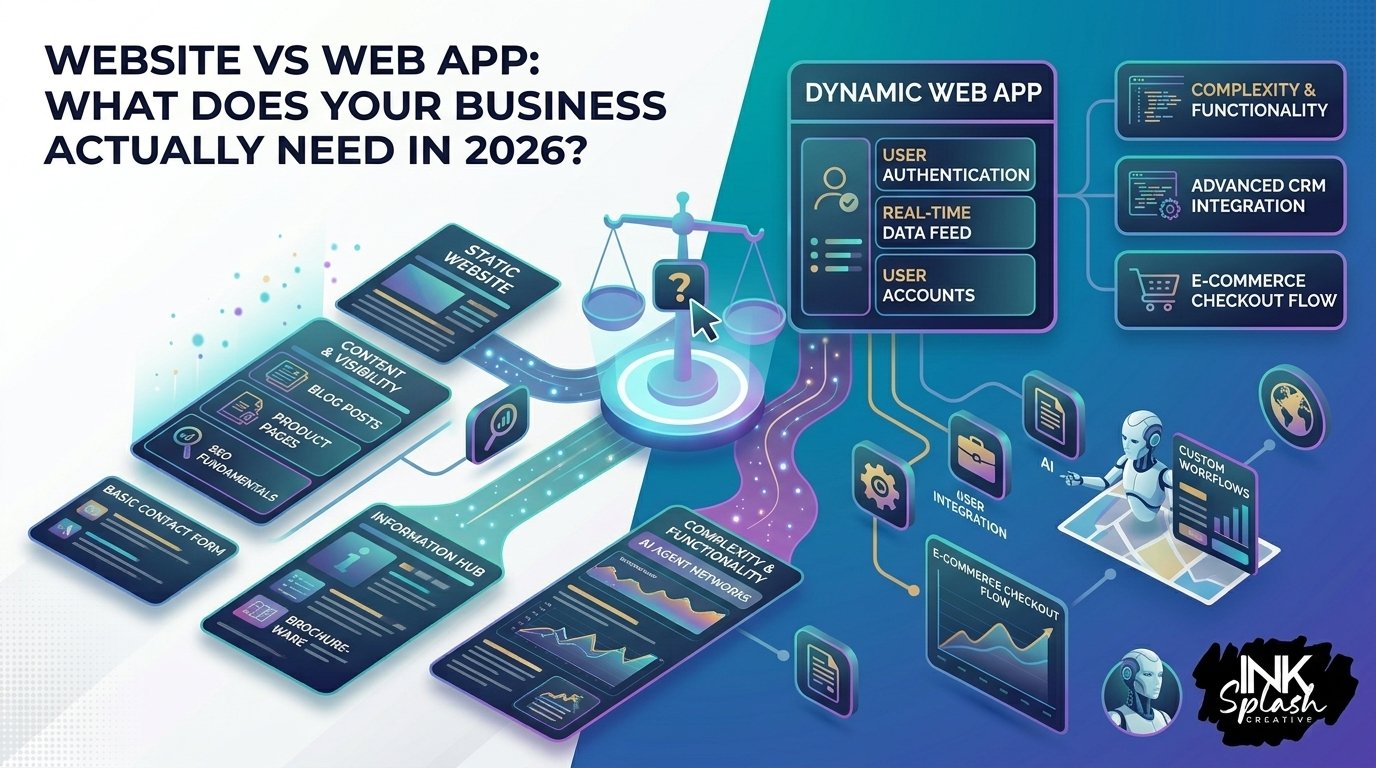
Website vs Web App: What Does Your Business Actually Need in 2026?
One of the most common mistakes businesses make when starting a digital project is choosing technology before defining the problem. A company may ask for a website when what it really needs is a web application. Another company may request an expensive custom platform when a well-designed CMS website would accomplish everything required. Understanding the difference between a website and a web application can save your business time, money, development effort, and future headaches.
The right solution depends on what your users need to do.
If visitors mainly need to read information, understand your services, see your portfolio, contact you, or purchase products, a traditional website may be enough. If users need accounts, dashboards, complex workflows, bookings, transactions, personalized information, or interaction with databases, you may need a web application.
What Is a Business Website?
A business website primarily communicates information.
Typical pages include:
- Home
- About
- Services
- Products
- Blog
- Contact
- FAQs
- Portfolio
- Testimonials
The purpose is generally to help visitors understand the business and take an action.
That action could be submitting a lead form, calling the company, booking an appointment, requesting a quote, or purchasing a product.
A modern business website can still be extremely sophisticated. It can integrate payment gateways, CRMs, email platforms, analytics, booking systems, chatbots, and marketing automation.
The key difference is that the website's primary role is presentation and conversion.
What Is a Web Application?
A web application is more interactive.
Users don't simply read information. They perform tasks.
Examples include:
- CRM systems
- HR management systems
- Booking platforms
- Project management software
- Customer portals
- Learning management systems
- Inventory systems
- Membership platforms
- Financial dashboards
A web application typically involves authentication, databases, user roles, business logic, permissions, and dynamic information.
Instead of asking:
"How does this page look?"
The development team must also ask:
"What happens when this user clicks this button?"
"Which database record changes?"
"Who is allowed to perform this action?"
"What happens if payment fails?"
"What happens if two users modify the same record?"
That is application engineering.
Website vs Web App: The Key Difference
FeatureBusiness WebsiteWeb ApplicationMain purpose | Information & conversion | Interaction & functionality
User accounts | Optional | Common
Database | Often limited | Usually central
Dashboard | Rare | Common
Complex workflows | Limited | Extensive
User roles | Basic | Advanced
Transactions | Possible | Common
Development complexity | Low to medium | Medium to high
Maintenance | Relatively simple | Ongoing engineering
Best for | Marketing | Business operations
The distinction isn't always absolute.
Modern websites can contain application-like features, while web applications can include extensive marketing pages.
The important question is what the platform needs to accomplish.
When a CMS Website Is the Better Choice
If your primary objective is marketing, a CMS website can be an excellent option.
A CMS makes it easier for teams to publish content, update pages, manage blogs, and maintain their digital presence without requiring developers for every small change.
For businesses focused on SEO, content marketing, lead generation, and brand visibility, a CMS can provide an excellent foundation.
You can then connect external tools for:
- CRM
- Email marketing
- Analytics
- Booking
- Payments
- Chatbots
- Marketing automation
This approach can be much more efficient than building everything from scratch.
When You Need a Custom Web Application
A custom application makes more sense when the business has unique workflows that existing software cannot handle effectively.
For example, suppose you operate a membership business.
You may need:
- Multiple membership plans
- Membership freezes
- Renewals
- Check-ins
- Payments
- Discounts
- Add-ons
- Staff permissions
- Customer profiles
- Reports
- Notifications
At that point, the system is no longer simply a website.
It is business software delivered through the web.
Don't Build Custom Software Just Because You Can
Custom development can be powerful, but it comes with responsibility.
You need to consider:
- Development
- Hosting
- Security
- Backups
- Maintenance
- Updates
- Testing
- Monitoring
- Scalability
- User support
A custom application should solve a real business problem.
If a proven platform already does what you need, buying or configuring it may be more economical.
But when your business processes are unique, custom development can provide much greater flexibility.
How AI Changes Web Development
AI is also changing the way websites and web applications are designed.
Businesses can now integrate AI features such as:
- AI chatbots
- AI search
- AI document processing
- AI recommendations
- AI content generation
- AI customer support
- AI lead qualification
- AI reporting
This means a modern website can become much more than a digital brochure.
It can become an intelligent interface between your business and your customers.
At the same time, AI should not be added simply because it is fashionable. The feature should have a measurable purpose.
The Right Technology Starts With Business Requirements
Before choosing Laravel, Vue, WordPress, Shopify, React, or another technology, define the business requirements.
Ask:
Who will use the system?
What will they do?
What information needs to be stored?
Who can access it?
Which actions require approval?
What integrations are required?
How many users might use it?
What happens when the business grows?
Those questions should determine the architecture.
Technology should support the business—not the other way around.
Your Website Can Become Your Growth Engine
A high-performing website should not simply exist.
It should attract traffic, explain your value proposition, build trust, capture leads, and convert visitors.
That means website development and marketing should not be treated as completely separate disciplines.
Your website architecture affects SEO.
Your page speed affects user experience.
Your content affects search visibility.
Your forms affect lead generation.
Your design affects conversion.
Your integrations affect operational efficiency.
The best digital platforms connect all of these pieces into one system.