

SEO vs Google Ads in 2026: Which Digital Marketing Strategy Is Better?
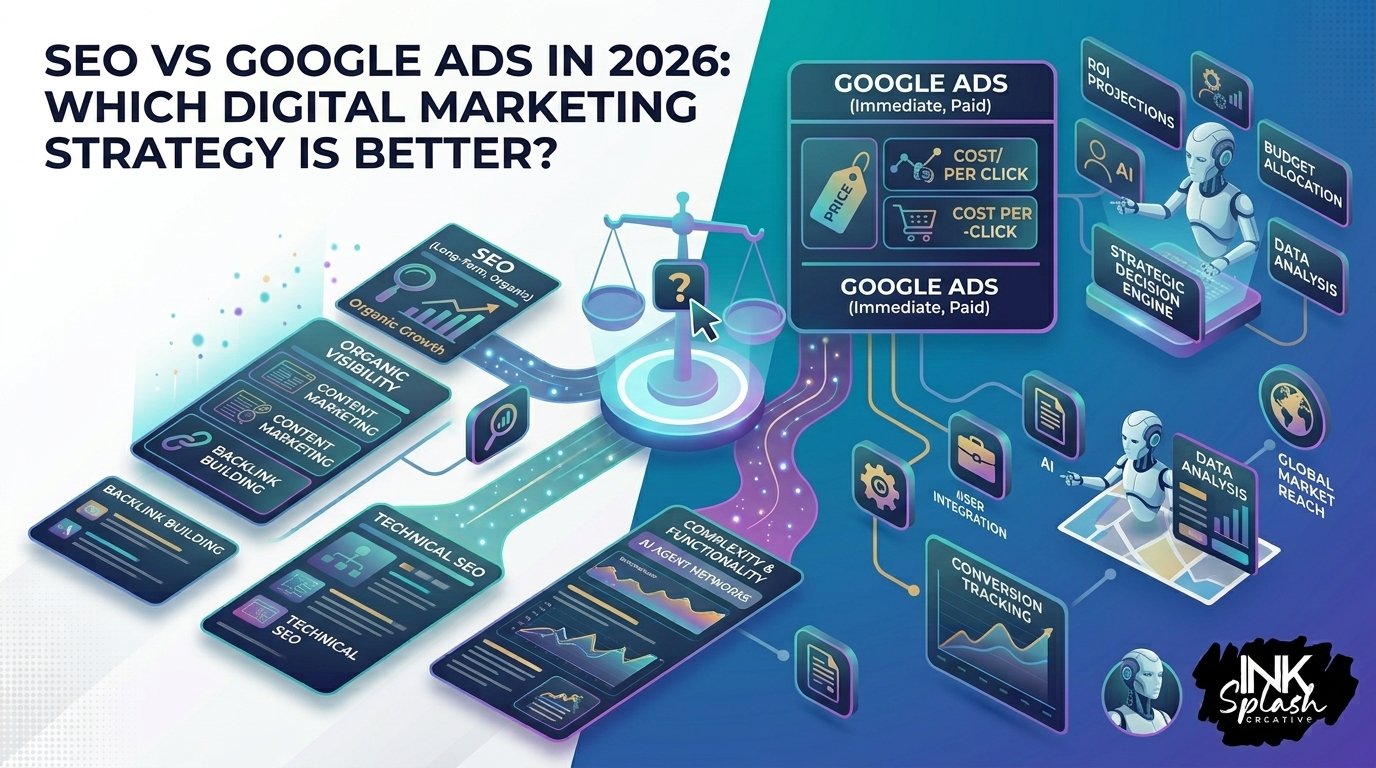
SEO vs Google Ads in 2026: Which Digital Marketing Strategy Is Better?
When businesses want more customers from Google, the same question often appears: Should we invest in SEO or Google Ads? The answer isn't as simple as choosing one. SEO and paid search solve different problems, operate on different timelines, and can work together to create a stronger customer acquisition strategy.
SEO is designed to build organic visibility over time. Google Ads allows businesses to pay for visibility when customers search for relevant terms. In 2026, the relationship between these channels is becoming even more interesting because AI-generated search experiences are increasingly appearing alongside commercial search results.
A recent Semrush study of more than 600,000 keywords found that AI Overviews on commercial-intent search results grew by 71% during the study period, while AI Overviews and Google Ads increasingly appeared together.
That means businesses need to think beyond the old SEO-versus-Ads debate.
What Is SEO?
Search Engine Optimization is the process of improving your website's organic visibility in search engines.
SEO typically includes:
- Keyword research
- Technical SEO
- Content creation
- On-page optimization
- Internal linking
- Digital PR
- Link acquisition
- Local SEO
- Conversion optimization
The goal is to build sustainable visibility for relevant searches.
If your business ranks organically for valuable keywords, you can continue receiving traffic without paying for every individual click.
But SEO takes time.
A new website generally cannot expect to dominate competitive searches immediately.
What Is Google Ads?
Google Ads provides paid search visibility.
Instead of waiting for your website to gain organic authority, you bid on relevant search terms and compete for advertising placements.
This can be extremely valuable when you need traffic quickly.
For example, a company launching a new service can create a campaign around high-intent searches and start generating qualified traffic much faster than waiting for organic rankings.
The downside is obvious:
You pay for the traffic.
When your advertising budget stops, the paid traffic usually stops as well.
SEO vs Google Ads Comparison
FactorSEOGoogle AdsTraffic speed | Slow to medium | Fast
Long-term value | High | Medium
Immediate visibility | Limited | Strong
Cost model | Investment in content/optimization | Pay per click/impression depending on campaign
Scalability | Strong | Budget dependent
Trust | Organic visibility can build credibility | Clearly identified as advertising
Best for | Sustainable growth | Immediate demand capture
Neither strategy automatically wins.
The right choice depends on your objectives.
When Google Ads Makes More Sense
Google Ads can be particularly useful when:
- You need leads quickly.
- You are launching a new service.
- You have high-value customers.
- Your search intent is strongly commercial.
- You have a profitable conversion funnel.
- You can track revenue accurately.
- You want to test keyword demand.
Suppose you sell a service worth $5,000.
If a properly optimized campaign generates a customer for $500, the advertising cost may be completely reasonable.
That is why looking at CPC alone can be misleading.
The real metric is customer acquisition economics.
When SEO Makes More Sense
SEO becomes especially attractive when:
- Customers repeatedly search for your services.
- You have valuable informational topics.
- You want long-term organic traffic.
- Your industry has expensive advertising clicks.
- You can publish high-quality content consistently.
- Your website has room to build authority.
SEO can become a compounding asset.
One strong article can attract traffic for years.
One useful service page can rank for dozens of related searches.
One authoritative resource can earn links and brand mentions.
The investment continues producing value after publication.
Why Combining SEO and Google Ads Is Powerful
Instead of treating SEO and paid search as competing departments, use the data from each to improve the other.
Google Ads can tell you which keywords generate conversions.
SEO can then prioritize those topics.
SEO can identify questions customers ask.
Paid search can test those topics quickly.
Together, the channels create a feedback loop.
For example:
Google Ads → Identify profitable keyword → Create SEO content → Build organic visibility → Reduce dependency on paid traffic
This can be much more powerful than using either channel in isolation.
AI Search Changes the Equation
AI search is creating another layer of visibility.
Google's AI experiences can synthesize information from multiple sources, while customers increasingly use conversational AI systems for discovery. Semrush reported that AI-driven search is growing rapidly and that businesses need to think about visibility beyond traditional rankings.
This doesn't mean businesses should abandon Google Ads or traditional SEO.
Instead, it means the marketing strategy needs to become broader.
Your website should be optimized for humans.
Your content should be useful.
Your brand should be recognizable.
Your reputation should extend beyond your own website.
And your paid campaigns should target searches where immediate visibility has meaningful commercial value.
Measure Revenue, Not Vanity Metrics
A campaign can have thousands of clicks and still lose money.
An SEO campaign can generate large amounts of traffic without producing qualified leads.
The important metrics are:
- Leads
- Qualified leads
- Sales
- Revenue
- Cost per acquisition
- Conversion rate
- Customer lifetime value
- Return on ad spend
- Organic conversion rate
Marketing should ultimately connect visibility to business outcomes.
Traffic is useful.
Revenue is better.
The Best Strategy in 2026
For many businesses, the strongest approach is not SEO or Google Ads.
It is:
SEO + Google Ads + Conversion Optimization + Strong Website + AI Search Visibility
Each channel handles a different part of the customer journey.
Paid search captures immediate demand.
SEO builds sustainable visibility.
Content answers customer questions.
Conversion optimization turns traffic into leads.
A strong website builds trust.
AI search optimization expands discoverability.
That is the modern search marketing ecosystem.