

How to Get Your Business Found on Google and AI Search in 2026
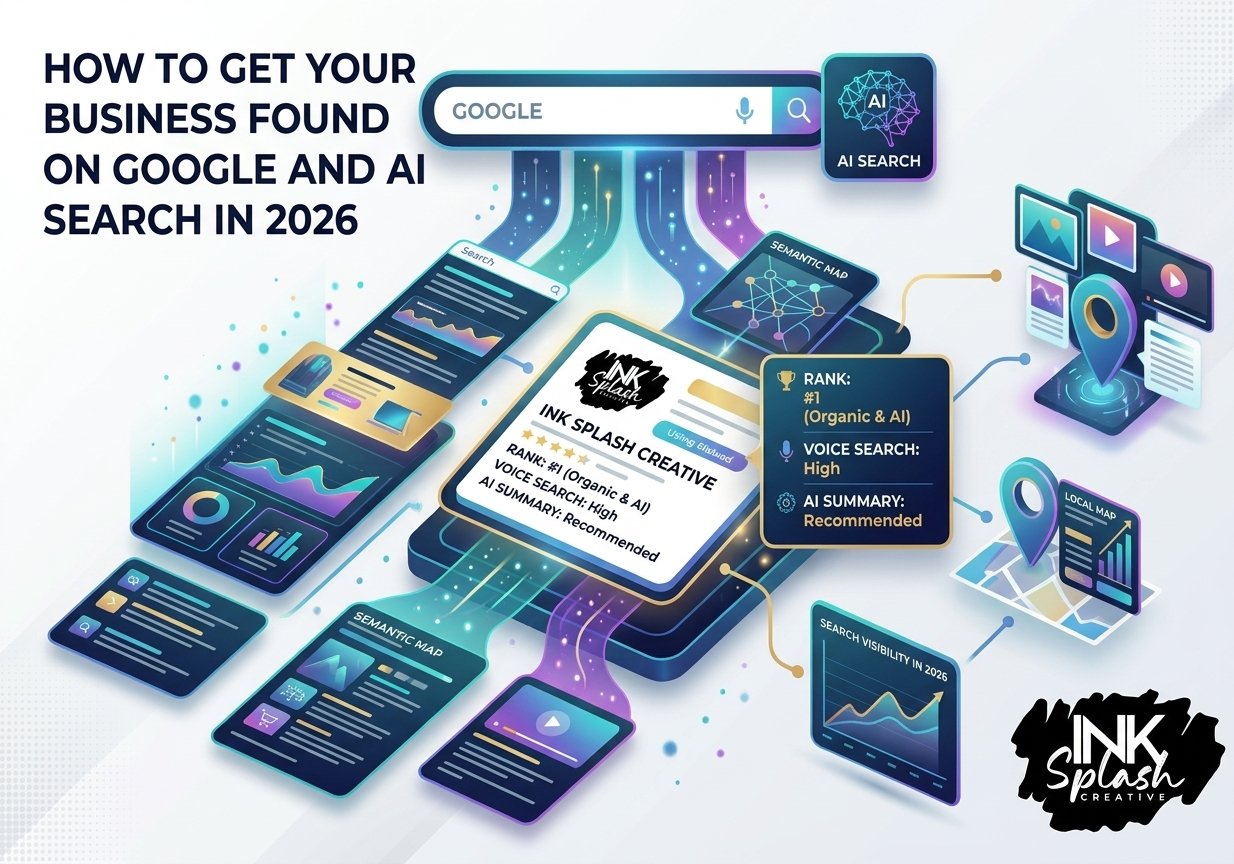
How to Get Your Business Found on Google and AI Search in 2026
Search is no longer just a list of ten blue links. A potential customer might search Google, read an AI Overview, ask ChatGPT for recommendations, compare businesses through an AI-powered tool, watch a YouTube video, check reviews, and then visit a website before making a decision. For businesses, this creates a much bigger opportunity, but it also changes what it means to be visible online. SEO in 2026 is no longer only about ranking a webpage; it is about becoming a trusted source that search engines and AI systems can understand, reference, and recommend.
Google itself continues to emphasize unique, useful content for its generative search experiences. Google has also introduced guidance specifically around optimizing for generative AI features while reinforcing the importance of established SEO fundamentals.
Why SEO Is Changing in 2026
For years, businesses focused on ranking individual keywords. A company might target phrases such as "web development company," "SEO agency," or "digital marketing services" and build pages around those terms. That strategy still matters, but search behavior has become more conversational and fragmented.
A customer can now ask a much more detailed question: "What is the best SEO strategy for a small B2B company that wants leads from Google?" Instead of receiving only individual webpages, the user may receive a synthesized answer generated from multiple sources.
That changes the competition.
Your website still needs strong technical SEO, relevant keywords, internal linking, structured content, and authoritative backlinks. But your business also needs clear expertise, consistent brand information, useful original content, and a reputation across the web.
Semrush's 2026 research analyzed 126 million AI search prompts and found that AI-powered discovery is increasingly influencing how brands are mentioned, cited, and represented.
The lesson is simple: ranking is still important, but visibility now exists beyond traditional rankings.
What Is AI Search Optimization?
AI search optimization is the process of making your website, content, brand, and online presence easier for AI-powered search systems to understand and use.
You may see several terms used for this:
- AI SEO
- Answer Engine Optimization (AEO)
- Generative Engine Optimization (GEO)
- AI search optimization
- AI visibility
Although the terminology differs, the goal is similar: make your business more discoverable when customers search through traditional search engines and AI-powered interfaces.
A strong strategy starts with conventional SEO. Your website needs crawlable pages, useful content, appropriate metadata, good site architecture, fast performance, and clear topical relevance.
Then you build on that foundation with content designed around real customer questions.
Instead of writing an article simply because a keyword has a high search volume, ask what problem the customer is trying to solve.
For example, a web development company could create:
"How Much Does a Business Website Cost in 2026?"
But it could go further by explaining pricing factors, technology choices, maintenance costs, ecommerce requirements, integrations, security, and conversion optimization.
That creates a resource capable of answering several related questions instead of targeting one phrase repeatedly.
Build Content That Deserves to Be Cited
One of the biggest mistakes businesses make with AI search is assuming that adding the phrase "AI SEO" to an article automatically makes the article optimized for AI.
It doesn't.
Search engines and AI systems need useful information.
Google's guidance emphasizes creating original, helpful content that provides value rather than producing generic material designed primarily for search engines.
Think about your content as evidence of expertise.
If your company offers SEO services, don't publish 50 generic articles saying that SEO is important. Publish practical material that demonstrates how you approach keyword research, technical SEO, content strategy, conversion optimization, reporting, and search intent.
Show your thinking.
Explain difficult concepts clearly.
Use examples.
Compare alternatives.
Answer objections.
Include original observations from your own projects where appropriate.
This makes your content much more valuable to humans and gives search systems more meaningful information to interpret.
Create Topic Clusters Instead of Random Blog Posts
A strong SEO strategy resembles a library rather than a pile of unrelated documents.
Your main service page could target:
Search Engine Optimization Services
Supporting articles could target:
- How SEO works for small businesses
- Technical SEO checklist
- SEO vs Google Ads
- How long SEO takes
- AI search optimization
- Local SEO strategies
- How to measure SEO ROI
- Common SEO mistakes
- Content optimization for AI search
Each article supports the broader topic.
Internal links then connect these pages together.
This creates topical depth and helps both visitors and search engines understand what your business specializes in.
Brand Authority Matters More Than Ever
Imagine asking an AI system:
"Which companies are good at AI automation?"
The system needs information about those businesses before it can confidently discuss them.
That means your website is only one part of your digital presence.
Your business can build authority through:
- Industry publications
- Customer reviews
- Business directories
- Social media
- Expert articles
- Podcasts
- YouTube
- Case studies
- Partnerships
- Community discussions
- Consistent company information
Semrush's 2026 research describes AI visibility as an ecosystem involving brand mentions, citations, and representation across AI-powered discovery.
In practical terms, businesses should stop thinking of SEO as "my website versus Google."
The modern competition is your entire digital footprint versus the customer's question.
Technical SEO Still Matters
AI search has not made technical SEO irrelevant.
Your website still needs to be accessible to search engines.
Pay attention to:
- Mobile responsiveness
- Page speed
- Crawlability
- Indexation
- Canonical URLs
- XML sitemaps
- Internal links
- Structured data
- HTTPS
- Clean URL structures
- Image optimization
- Helpful page titles
- Descriptive meta descriptions
Google's current guidance specifically reinforces that established SEO practices continue to matter for generative search features.
This is important because there is a tendency to treat AI search as an entirely separate discipline.
It isn't.
Think of AI search optimization as an extension of a strong digital foundation.
Measure Visibility Beyond Rankings
Traditional SEO reporting usually focuses on rankings, organic traffic, impressions, clicks, conversions, and backlinks.
Those metrics remain useful.
But businesses should increasingly watch:
- AI mentions
- AI citations
- Branded search growth
- Search impressions
- Referral traffic
- Conversion rates
- Featured snippets
- AI Overview visibility
- Content engagement
- Brand mentions across trusted websites
Google announced dedicated Search Console reporting for visibility from generative AI features, including AI Overviews and AI Mode, initially rolling the reporting out to a subset of websites.
That is a strong signal that AI visibility is becoming measurable rather than merely theoretical.
The Future of SEO Is Search Everywhere
The biggest opportunity is not replacing Google SEO with AI SEO.
It is building a strategy that works across both.
Your customers may discover your brand through Google, ChatGPT, social media, YouTube, review platforms, or another search interface.
The companies that adapt fastest will treat these channels as parts of one visibility strategy.
If your business has strong technical SEO, useful content, a recognizable brand, genuine authority, and a website built to convert visitors, you have a much stronger foundation for the next phase of search.
SEO isn't disappearing.
Search is expanding.