AI Employees in 2026: How AI Agents Are Automating Business Workflows
AI Employees in 2026: How AI Agents Are Automating Business Workflows
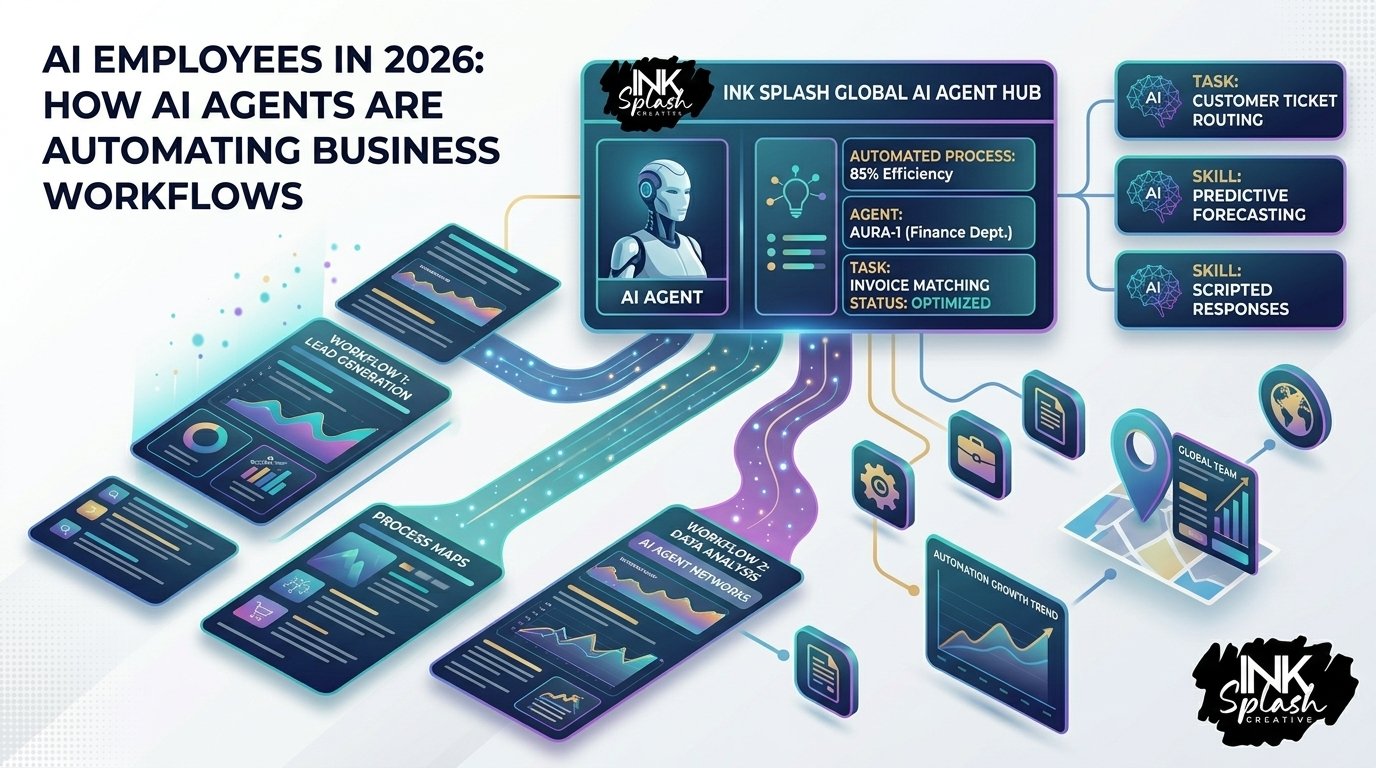
What if your business could have a digital team member that researches leads, organizes information, drafts responses, updates your CRM, prepares reports, and works through repetitive tasks without someone manually completing every step? That is the promise behind AI employees and AI agents. The technology is moving beyond simple chatbots toward systems that can interpret information, make decisions within defined boundaries, use connected tools, and execute multi-step workflows.
AI adoption is already mainstream across marketing and business operations. HubSpot's 2026 State of Marketing report says 64% of organizations use AI, while automation is identified as one of the major marketing trends for the year.
The real opportunity isn't simply adding AI to a business.
It is identifying the work that should never have required so much human time in the first place.
What Is an AI Employee?
An AI employee is essentially a business-oriented AI system designed to perform a defined role or group of responsibilities.
For example, an AI sales assistant could:
- Receive a new lead.
- Retrieve customer information.
- Research the prospect.
- Analyze the lead.
- Create a personalized email.
- Update the CRM.
- Send the message.
- Schedule a follow-up.
- Notify the sales representative.
The important distinction is that this is more than generating text.
The system is executing a workflow.
AI agents can combine language models with APIs, databases, business applications, automation platforms, and rules. This creates something closer to a digital worker than a traditional chatbot.
Why Businesses Are Investing in AI Automation
Businesses have always tried to automate repetitive work.
The difference now is that traditional automation works best when the process is predictable.
"If this happens, do this."
AI adds another layer because modern systems can interpret unstructured information.
Consider a customer email.
A traditional automation may struggle to determine whether the customer is asking about billing, technical support, cancellation, or a product recommendation.
An AI system can classify the request, identify its intent, extract relevant information, and then route it through the correct workflow.
That makes automation useful for processes that previously required human interpretation.
Where AI Employees Can Create the Most Value
Not every task should be automated.
The best candidates are usually repetitive, rules-based, time-consuming processes where employees spend significant time moving information between systems.
Common examples include:
- Lead qualification
- CRM updates
- Customer support
- Email follow-ups
- Appointment reminders
- Research
- Document processing
- Reporting
- Data extraction
- Content workflows
- Sales prospecting
- Internal knowledge retrieval
- Invoice processing
The goal is not to remove humans from the process.
The goal is to remove unnecessary manual work from humans.
AI Lead Generation
Lead management is one of the strongest use cases.
Imagine a lead arriving through your website.
Instead of a salesperson manually checking every detail, an AI workflow can immediately process the submission.
The workflow can retrieve additional information, enrich the lead, categorize it, score its potential value, research the company, and prepare a personalized outreach message.
The sales team then receives a qualified opportunity instead of a raw form submission.
That difference can dramatically change productivity.
A salesperson should ideally spend time talking to prospects, understanding requirements, handling objections, and closing deals—not copying information between five different systems.
AI Customer Support
Customer support is another natural application.
A traditional chatbot often answers a limited set of predefined questions.
An AI-powered support system can understand more conversational requests and use a knowledge base to generate relevant responses.
For example:
"My order hasn't arrived and I placed it last Thursday."
The system could identify the order, check its status, determine whether the expected delivery date has passed, and provide the customer with the appropriate next step.
For sensitive or complex cases, the AI can escalate the conversation to a human.
This creates a human-in-the-loop model rather than trying to make AI responsible for everything.
AI Employees Should Have Boundaries
This is one of the most important parts of AI automation.
An AI agent should not have unlimited authority simply because it can technically access a system.
Businesses should define:
- What the AI can read
- What it can change
- What it can send
- What requires approval
- What information it can access
- When it must escalate
- What actions are prohibited
For example, an AI sales assistant might be allowed to send a standard follow-up email but require human approval before sending a custom pricing proposal.
That boundary protects both the business and the customer.
AI Automation Is About Workflows, Not Magic
There is a temptation to ask:
"What can AI automate?"
A better question is:
"Where does my team lose the most time?"
Start there.
Map the workflow.
Identify the inputs.
Identify the decisions.
Identify the repetitive steps.
Identify the systems involved.
Then determine where AI actually adds value.
This prevents companies from building impressive AI demos that don't solve meaningful business problems.
AI Agents and Traditional Automation
Traditional automation and AI automation are not competitors.
They work well together.
A workflow might use conventional automation for predictable operations and AI for interpretation.
For example:
Webhook → Retrieve lead → AI qualification → CRM update → Personalized email → Human approval → Send
The webhook and CRM update can be deterministic.
The AI can handle the interpretation.
The human can handle the final high-value decision.
This hybrid approach is often more reliable than trying to make an AI agent responsible for the entire process.
The 2026 Opportunity
AI is becoming less about asking a chatbot questions and more about integrating intelligence into everyday operations.
HubSpot's 2026 research identifies automation and AI-powered personalization among the major marketing trends businesses are adopting.
That means the competitive advantage will increasingly come from how well a business designs its AI workflows, not simply whether it has access to an AI model.
The businesses that benefit most will identify repetitive processes, connect their systems, establish appropriate controls, and continuously improve their workflows.
An AI employee shouldn't be viewed as a gimmick.
Used correctly, it can become a scalable layer of business infrastructure.